By Gary Eleazar
The National Assembly last evening made a historic move when it
unanimously approved the removal of the mandatory use of the death
penalty for persons convicted of murder.
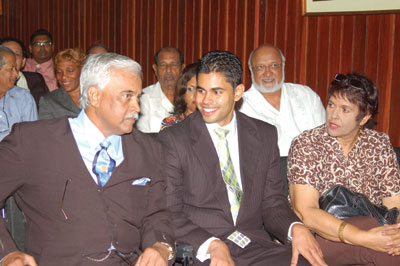
From
left, newly appointed Attorney General and Minister of Legal Affairs,
Mr. Charles Ramson, S.C; his wife Mrs. Leila Ramson and son, Charles
Ramson, Jr
This was done when Attorney General and Minister of Legal Affairs,
Charles Ramson, successfully piloted the Criminal Law Offences
(Amendment) Bill.

In his presentation to the House, Ramson said that at present the
principal act does not allow leeway for judges, in that once a jury
convicts a person of murder, then the Judge must notify the convicted
that they will be sentenced to death lawfully.
He said that over the years there has been an outcry as it relates to
the death penalty and the amendments now allow for alternatives to be in
place for the judge.

The abolition is not total since it will still be mandatory for certain
categories of murder.
He explained these as being the killing of a law enforcement official
while on duty, prison officers, members of the judiciary and legal
officers, witnesses, as well as jurors, while in the execution of their
duties.

Ramson pointed to the fact that ever since the 1950s the country’s
colonial masters, by way of the Homicide Act, abandoned the mandatory
death sentence in their country but left it in place for their colonies.
He said that what was not good for them was still deemed okay for their
colonies.
Ramson asserted that the issue has now become a moral and human rights
issue, and in recent times, the calls have been growing for it to be
addressed.
The amendments allow for a judge to issue a life sentence of or a
minimum of 15 years or any amount above that.
Shadow Legal Affairs Minister Clarissa Riehl, in her presentation to the
House, recognized the need for certain categories of murders to be
retained, but said too that one specific category that should have been
retained also was murders as a result of domestic violence.
Riehl lamented the many murders in recent times which have occurred as a
result of prolonged domestic violence which is a scourge that has been
tainting society.
Scores of women have been slaughtered in recent years at the hands of
their abusive lovers and according to Riehl, it should have been left in
the law to have such persons face the mandatory death penalty.
She was also of the opinion that murders as a result of piracy and
hijacking should also be subjected to the death penalty.
Riehl reminded the House that it was only recently that the laws were
amended to make killings at the hands of pirates punishable by death.
Now, she said, the government is changing this.
At present, a person will be eligible for parole after serving at least
a third of their sentence, but with the new amendments, Riehl pointed
out that a person must now serve 20 years before becoming eligible.
She sought to clarify whether it was calendar years or prison years,
which she said is in actuality just eight months.
Riehl questioned whether the allowed 15-year minimum sentence for murder
would also be prisons years, which would make the sentence far less than
15 calendar years.
She asked if it would now be possible for a person to kill during a
domestic spat and be sentenced to just 15 years.
Riehl said that the administration should start paying more attention to
the root causes of crime in Guyana, as many laws are being passed with
stiffer penalties but the desired result is not being achieved.
One example cited was the fact that there is the law that a person
should not be using cellular phones whilst driving, but this is still
happening blatantly, even in front of police stations.
People’s Progressive Party/Civic Member of Parliament and
Attorney-at-Law, Anil Nandlall, in his presentation to the house, sought
to explain the context in which the law was being passed.
He pointed out that the law was passed 117 years ago, and provides for
the mandatory sentence of death should that persons be convicted of
murder.
“What this does is it retains the death penalty but also provides an
alternative.”
Nandlall told the House that it must be noted that when one interacts
with people, their reactions to certain violent crimes is invariably why
the death penalty is not being used.
He said that it must also be noted that there are several large human
rights organizations and conventions, many of which Guyana have signed
on to, which are calling for the abolition of the death penalty, and no
democracy can ignore these calls.
He said that what the amendments does is provide a delicate balance,
adding that Government’s obligation is to use the law as a mechanism
to find common ground and bridge the gap.
Nandlall did impress upon the House that there is something
fundamentally wrong with a mandatory death penalty across the board.
Friday, October 15, 2010




